 Forum on Child and Family Statistics
Sexual Activity
Early sexual activity is associated with several problematic behaviors, including adolescent substance use, academic underachievement, and emotional and physical health risks.1 Youth who engage in sexual activity are at risk of contracting sexually transmitted infections (STIs) and becoming pregnant.2 STIs, including HIV, can infect a person for a lifetime and result in severe health consequences.3 Delayed sexual activity is associated with a decreased risk of contracting STIs.2 In addition, teen pregnancy is associated with several negative risk factors for both the mother and her child (see FAM2).
Indicator BEH4.A Percentage of high school students who reported ever having had sexual intercourse by grade, selected years 1991–2023
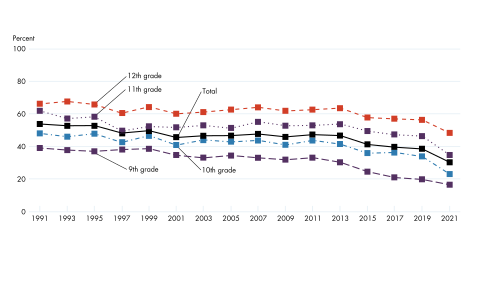
NOTE: Students were asked, "Have you ever had sexual intercourse?" Data are collected biennially.
SOURCE: Centers for Disease Control and Prevention, National Center for Chronic Disease Prevention and Health Promotion, Youth Risk Behavior Surveillance System.
- The percentage of high school students who reported ever having had sexual intercourse decreased from 54% in 1991 to 46% in 2001 and was relatively stable through 2013 (47%). The percentage then decreased to 38% in 2019 before stabilizing around 30% in 2021.4 In 2023, 32% of high school students reported ever having had sexual intercourse.
- Between 1991 and 2023, the percentage of high school students who reported ever having had sexual intercourse decreased for all four grades: 9th grade (39% to 17%), 10th grade (48% to 25%), 11th grade (62% to 38%), and 12th grade (67% to 48%).
Indicator BEH4.B Among high school students who had sexual intercourse in the past 3 months, the percentage who reported condom use during their last sexual intercourse, selected years 1991–2023
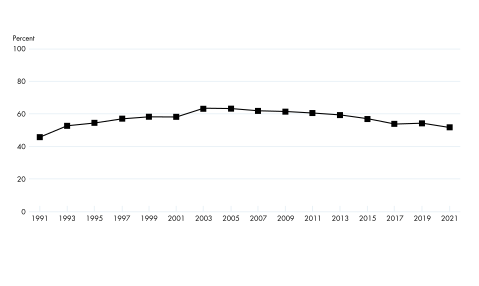
NOTE: Students were asked, "The last time you had sexual intercourse, did you or your partner use a condom?" Data are collected biennially.
SOURCE: Centers for Disease Control and Prevention, National Center for Chronic Disease Prevention and Health Promotion, Youth Risk Behavior Surveillance System.
Indicator BEH4.C Among high school students who had sexual intercourse in the past 3 months, the percentage who reported birth control pill use before their last sexual intercourse, 2021 and 2023
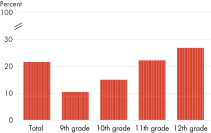
NOTE: Students were asked, "The last time you had sexual intercourse, what one method did you or your partner use to prevent pregnancy?" "Birth control pills" was one option. Data are collected biennially.
SOURCE: Centers for Disease Control and Prevention, National Center for Chronic Disease Prevention and Health Promotion, Youth Risk Behavior Surveillance System.
- Among high school students who had sexual intercourse in the past three months, the percentage who reported they or their partner used a condom the last time they had intercourse increased from 46% in 1991 to 63% in 2003, decreased to 52% in 2021, and remained stable through 2023.
- Among sexually active high school students, the percentage who used birth control pills to prevent pregnancy before the last time they had sexual intercourse (not counting emergency contraception such as Plan B or the "morning after" pill) was 21% in 2021 and remained stable through 2023 (20%), ranging from 10% in 9th grade to 24% in 12th grade.
 BEH4.A HTML Table | BEH4.B HTML Table | BEH4.C HTML Table
1 Reis, L. F., Surkan, P. J., Atkins, K., Garcia-Cerde, R., & Sanchez, Z. M. (2023). Risk factors for early sexual intercourse in adolescence: A systematic review of cohort studies. Child Psychiatry and Human Development, 55, 1677–1690. https://doi.org/10.1007/s10578-023-01519-8
2 Inanc, H., Meckstroth, A., Keating, B., Adamek, K., Zaveri, H., O'Neil, S., McDonald, K., & Ochoa, L. (2020). Factors influencing youth sexual activity: Conceptual models for sexual risk avoidance and cessation (OPRE Research Brief 2020-153). U.S. Department of Health and Human Services, Administration for Children and Families, Office of Planning, Research, and Evaluation. https://www.acf.hhs.gov/sites/default/files/documents/opre/factors-influencing-youth-sexual-activity-dec-2020_0.pdf
3 Allan-Blitz, L., & Klausner, J. (2025). The impacts and consequences of sexually transmitted infections in the United States. Sexually Transmitted Diseases, 52(5), 285–289. https://doi.org/10.1097/olq.0000000000002126
4 Beginning in 2011, t-tests were used for this report to test for statistically significant differences between groups. Comparisons of confidence intervals were used to test for statistically significant differences prior to 2011.
Federal Interagency Forum on Child and Family Statistics
