 Forum on Child and Family Statistics
Youth Perpetrators of Serious Violent Crimes
Youth who commit violent crimes tend to exhibit multiple problematic behaviors that affect their well-being, including drug use, risky sexual behaviors, and problems in school.1 One measure of youth violence is the rate of serious violent crimes committed by juveniles. Because insufficient data exist to determine the ages of each individual offender when a crime is committed by more than one perpetrator, the number of additional juvenile offenders cannot be determined. Therefore, this rate of serious violent crime offending does not represent the number of juvenile offenders in the population but rather the rate of crimes perpetrated by juveniles as perceived by victims.
Indicator BEH5.A Rate of serious violent crimes by youth perpetrators ages 12–17, 2005–2023
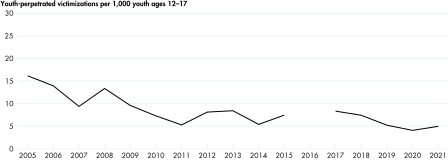
NOTE: The rate is the ratio of the number of crimes (i.e., aggravated assault, rape, and robbery [stealing by force or threat of violence]) reported to the National Crime Victimization Survey (NCVS) that involved at least one offender perceived by the victim to be ages 12–17, plus the number of homicides reported to the police that involved at least one known juvenile offender, to the number of juveniles in the population. In 2023, homicides represented 0.9% of serious violent crime, and the total number of homicides by juveniles has been relatively stable over the last decade. Beginning in 2021, the number of homicides were estimated using the FBI's National Incident-Based Reporting System. From 1993 to 2020, the number of homicides was estimated using the FBI's Supplementary Homicide Reports. Due to methodological changes in the 2006 NCVS, use caution when comparing 2006 criminal perpetration estimates with those for other years. See Criminal Victimization, 2007 (https://bjs.ojp.gov/content/pub/pdf/cv07.pdf) for more information on the redesigned methodology. Estimates for 2016 are not included because, in 2016, the NCVS sample was redesigned, so 2016 estimates among youth are not comparable with estimates from other years. In 2020, historical estimates were revised since previous publication in America's Children due to changes in the methodology for calculating offender totals for youth and revisions to homicide numbers. The 2020 NCVS weights include an additional adjustment to address the impact of modified field operations due to the COVID-19 pandemic. For more information on the weighting adjustments applied in 2020, see the Source and Accuracy Statement for the 2020 NCVS in the NCVS 2020 Codebook (https://www.icpsr.umich.edu/web/NACJD/series/95) and Criminal Victimization, 2020 (https://bjs.ojp.gov/sites/g/files/xyckuh236/files/media/document/cv20.pdf).
SOURCE: Bureau of Justice Statistics, National Crime Victimization Survey and Federal Bureau of Investigation, Uniform Crime Reporting Program, National Incident-Based Reporting System.
Indicator BEH5.B Percentage of youth-perpetrated serious violence involving multiple offenders ages 12–17, 2005–2023

NOTE: In 2016, the National Crime Victimization Survey (NCVS) sample was redesigned, so 2016 estimates among youth are not comparable with estimates from other years. In 2020, historical estimates were revised since previous publication in America's Children due to changes in the methodology for calculating offender totals for youth and revisions to homicide numbers. Due to methodological changes in the 2006 NCVS, use caution when comparing 2006 criminal perpetration estimates with those for other years. The 2020 NCVS weights include an additional adjustment to address the impact of modified field operations due to the COVID-19 pandemic. For more information on the weighting adjustments applied in 2020, see the Source and Accuracy Statement for the 2020 NCVS in the NCVS 2020 Codebook (https://www.icpsr.umich.edu/web/NACJD/studies/38090/summary) and Criminal Victimization, 2020 (https://bjs.ojp.gov/sites/g/files/xyckuh236/files/media/document/cv20.pdf).
SOURCE: Bureau of Justice Statistics, National Crime Victimization Survey and Federal Bureau of Investigation, Uniform Crime Reporting Program, National Incident-Based Reporting System.
- In 2023, the serious violent crime offending rate for youth ages 12–17 was 6 crimes per 1,000. There were a total of 162,100 serious violent crimes involving juvenile offenders. This was not significantly different from the rate in 2022.
- From 2005 to 2023, the serious violent crime offending rate for juveniles ages 12–17 declined 62% from 17 to 6 crimes per 1,000.
- In 44% of all serious violent crimes perpetrated by juveniles ages 12–17 in 2023, more than one offender was involved in the incident.

1 Huizinga, D., Loeber, R., Thornberry, T., & Cothern, L. (2000). Co-occurrence of delinquency and other problem behaviors (NCJ Number 182211). U.S. Department of Justice, Office of Juvenile Justice and Delinquency Prevention. https://ojjdp.ojp.gov/library/publications/co-occurrence-delinquency-and-other-problem-behaviors
Federal Interagency Forum on Child and Family Statistics
